Quick Summary:
- Seven Magic Mountains is a free outdoor art installation ~10 miles south of the Las Vegas Strip on I-15 South.
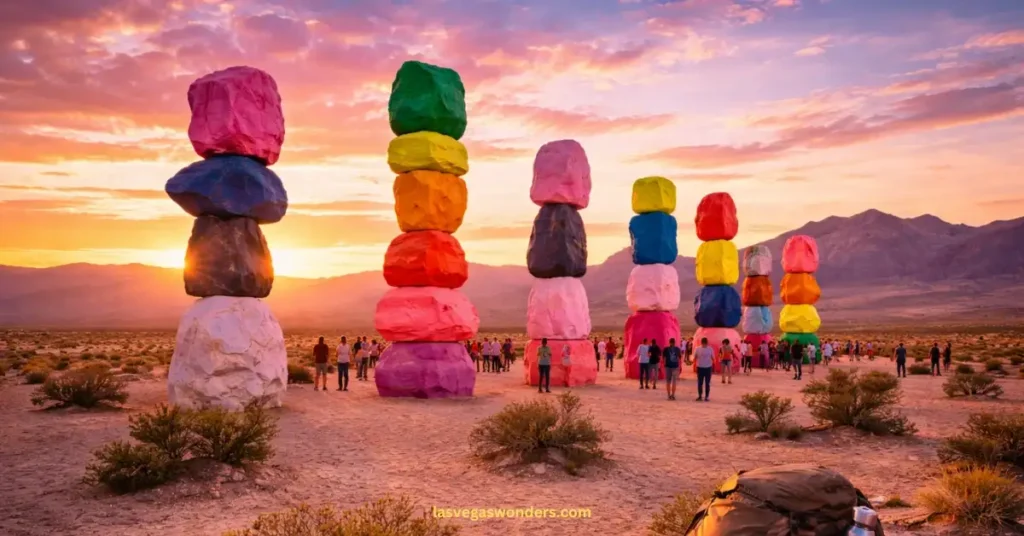
- Seven stacks of neon-painted limestone boulders, each reaching 30–35 feet tall, rise straight out of the Mojave Desert floor.
- No tickets, no reservations, no entrance fee — park and walk up.
- Budget 20 to 40 minutes. Perfect add-on when driving south from Las Vegas.
You’re driving south on I-15 when something stops your sentence mid-word. Out the window: enormous stacks of hot-pink, acid-yellow, and electric-blue boulders, perfectly balanced in the middle of a flat brown desert. Nothing else around them. Just Mojave scrub and mountains in the distance.
That’s Seven Magic Mountains — and it’s exactly as strange and satisfying as it looks from the highway.
What Seven Magic Mountains Actually Is
Seven Magic Mountains is a large-scale public art installation created by Swiss artist Ugo Rondinone. It opened in May 2016 as a temporary piece and proved so popular that it’s been extended repeatedly. As of 2024, it holds permanent status as a long-term public artwork on Bureau of Land Management land just off I-15.
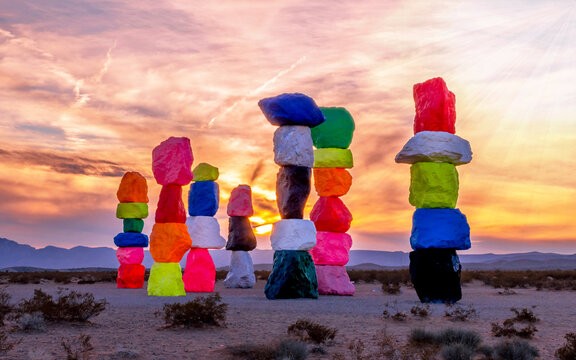
The installation consists of seven stacks of locally quarried limestone boulders, each painted in fluorescent colors and balanced vertically. The tallest stacks reach around 30 to 35 feet. Set against the flat Mojave floor with the Spring Mountains as a backdrop, the colors register almost physically — a genuine visual jolt in one of the quietest stretches of Nevada desert.
The project is managed jointly by the Art Production Fund and the Nevada Museum of Art.
How to Get to Seven Magic Mountains from Las Vegas
From the Strip, take I-15 South for about 10 miles. Take Exit 12 (Jean/Sloan Road). The installation is visible directly from the highway — the neon colors against the brown desert make it impossible to miss. A paved parking lot sits right next to the site.
- Drive time from the Strip: 15 to 20 minutes, no traffic
- Google Maps: Search “Seven Magic Mountains” — it’s well-listed
- GPS: 35.9924° N, 115.1754° W
A few practical notes: there’s no gas station nearby and no formal restroom facility — just a portable toilet in the parking lot. Grab water and whatever you need before leaving the city. Don’t count on finding anything once you exit the freeway.
What Visiting Seven Magic Mountains Actually Feels Like
You park. You walk about 200 feet. And then you’re standing next to boulders the size of small houses painted in colors that have absolutely no business existing in a desert. It’s disorienting, a little funny, and genuinely striking.
People experience it differently. Some visitors do a quick lap, read the informational signs, and are back in the car in 15 minutes. Others spend 45 minutes working every angle as the light shifts. If you’re there during golden hour — the 45 minutes before sunset — the neon against the warm desert sky produces photos that look almost artificially enhanced. They aren’t.
There’s something unexpectedly affecting about the place if you give it a moment. Rondinone described the work as a dialogue between the natural and the artificial — the untouched Mojave stretching endlessly in one direction, Las Vegas, the ultimate man-made landscape, sitting just over the horizon in the other. Whether that framing resonates with you or you just want the photo, both are completely valid reasons to stop.
Best Time to Visit Seven Magic Mountains
Golden hour and sunrise are the clear winners. Low-angle light makes the colors glow and carves deep shadows into the boulder faces. Midday light flattens everything — and in summer, midday heat makes lingering outdoors genuinely unpleasant.
- Spring and fall: Best all-around conditions. Comfortable temperatures, excellent light.
- Winter mornings: Cold, but often spectacular — clear blue sky, crisp air, minimal crowds.
- Summer: Arrive before 8 AM or just before sunset. Midday temperatures routinely exceed 100°F at this location.
Weekday mornings beat weekend afternoons significantly. On a Saturday afternoon in spring, the parking lot fills, and the boulders get crowded with people competing for the same angle. On a Tuesday morning, you can stand in front of the whole installation alone for stretches. If your schedule gives you a choice, take the weekday.
Photography Tips for Seven Magic Mountains
A large part of the appeal here is visual — this is a piece of public art designed to be seen and photographed. Here’s what actually works:
- Shoot from low angles. Getting low and pointing upward makes the stacks look dramatically taller against the sky.
- Use the desert floor as foreground. Cracked Mojave earth in the foreground with the colored boulders behind it creates strong depth and context.
- Wait out the crowd. People move. A 60-second pause at a busy spot will often clear the frame better than repositioning entirely.
- Shoot the full installation. All seven stacks visible at once, with the Spring Mountains behind — this wide shot is just as compelling as the close-up detail work.
- Try blue hour. The 15 to 20 minutes just after sunset give the whole scene a moody, almost artificially lit quality. Completely different from the golden-hour version — worth experimenting with if you have the time.
Is Seven Magic Mountains Worth Stopping For?
Yes — especially if you’re already on I-15 South. That road leads directly to Primm, Jean, and eventually Los Angeles, so “passing by” describes a large portion of visitors heading south from Las Vegas.
It’s free. It takes 20 to 40 minutes. It’s one of those experiences that’s genuinely hard to communicate beforehand, but easy to appreciate the moment you’re standing in front of it.
If you’re making a dedicated drive specifically for Seven Magic Mountains, pair it with something nearby. Sloan Canyon National Conservation Area is about 5 miles east — free entry, legitimate hiking, and one of the most significant petroglyph panels in southern Nevada. The two together make a solid, unhurried half-day outside the city without the longer drive that Red Rock Canyon or Valley of Fire requires.
Nearby Stops Worth Combining
- Sloan Canyon National Conservation Area: About 5 miles east of the installation. The Newspaper Rock petroglyph panel here contains hundreds of ancient carvings and is one of the most impressive sites of its kind in the region. Free to enter, good hiking terrain, rarely crowded.
- Jean, Nevada: A few miles further south. The casinos that once defined this tiny desert town are mostly closed now, but the ghost-town-adjacent atmosphere has its own strange appeal for people who find that sort of thing interesting.
- Primm, Nevada: About 20 miles south on I-15. A functioning casino, a well-stocked outlet mall, and the Desperado roller coaster — one of the tallest in the western United States — if someone in your group wants to extend the day in a completely different direction.
Seven Magic Mountains Is Worth the exit.
It costs nothing. It takes half an hour. And it’s one of those stops that earns a permanent place in your memory of the trip — not because it’s grand or ancient or historically significant, but because nothing quite prepares you for neon-painted boulders balanced in a flat brown desert with mountains behind them and Las Vegas just out of frame.
Seven Magic Mountains doesn’t ask much of you. Pull off I-15, walk 200 feet, and look up. That’s the whole deal. And it’s enough.
Pro tip: Charge your phone in the car on the way there. This is exactly the kind of place where a dead battery in the parking lot becomes a genuine regret.
FAQ: Seven Magic Mountains Las Vegas
Is Seven Magic Mountains free?
Completely free. No ticket, no timed entry, no reservation required. Park in the free lot and walk straight over. The visit takes 20 to 40 minutes, depending on how long you want to stay.
Is Seven Magic Mountains permanent?
Yes. After several extensions following its 2016 opening, the installation was designated a long-term public artwork. It’s not scheduled for removal, though a quick check of the Art Production Fund website before your visit is always a good idea.
How long should I spend at Seven Magic Mountains?
Most visitors are satisfied in 20 to 30 minutes. Photographers and people who want to experience the light shift at golden hour might stay up to an hour. It’s a great add-on stop, not a standalone full-day destination.
Can I touch or climb the boulders?
Signage asks visitors not to climb the stacks or touch the painted surfaces — contact over time damages the paint. Plenty of compelling photos are possible from the ground without getting on the rocks.
What’s the best time of day to photograph Seven Magic Mountains?
The 45 minutes before sunset consistently produce the strongest results. Warm desert light makes the fluorescent colors saturate deeply. Sunrise is equally good photographically and significantly less crowded — worth the early alarm if you can manage it.
Keep Reading:
- Valley of Fire State Park: The Ultimate Las Vegas Day Trip Guide
- Red Rock Canyon Las Vegas: Must-See Views & Hikes, Travel Tips
- Hoover Dam Tour Guide: Best Views, Tickets & Tips
- Bellagio Conservatory & Botanical Gardens: What to See
- Shark Reef Aquarium at Mandalay Bay Las Vegas: Tickets, Sharks & Tips
- OMNIA Nightclub Guide: DJs, Dress Code & Entry Tips