Key Highlights:
- The Layout: The Las Vegas Strip Circuit is a 3.853-mile (6.201 km) street circuit with 17 corners and a counter-clockwise layout.
- The Speed: Formula 1 cars can reach speeds above 210 mph on the long Las Vegas Boulevard section.
- Overtaking Areas: Heavy braking zones, particularly near the end of the Strip straight, create some of the circuit’s main passing opportunities.
- Viewing Areas: Grandstands and hospitality areas are spread around Grand Prix Plaza, the Sphere area, and other sections of the circuit.
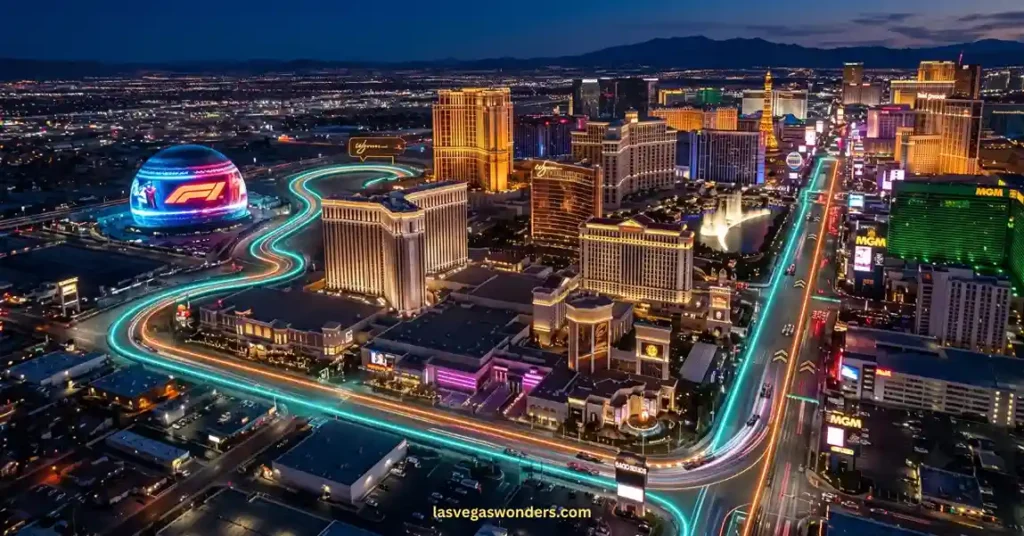
The Las Vegas F1 Track Map is unlike most Formula 1 circuits. Instead of taking place entirely at a permanent racetrack, much of the race uses public roads around the Las Vegas Strip, including Las Vegas Boulevard, Koval Lane, Harmon Avenue, and Sands Avenue.
The result is a fast street circuit combining long straights with slower turns and heavy braking zones. Understanding the route makes it easier to follow the race and choose where to watch during Grand Prix weekend.
Las Vegas F1 Circuit Quick Information
| Circuit Feature | Track Details |
|---|---|
| Track Length | 3.853 miles (6.201 km) |
| Total Corners | 17 |
| Race Direction | Counter-clockwise |
| Longest Straight | About 1.2 miles |
| Race Distance | 50 laps |
| Main Setting | Las Vegas Strip and surrounding streets |
Full Info: Formula 1 Las Vegas Grand Prix 2026: Race Weekend Schedule & Tickets
Understanding the Las Vegas F1 Track Map
The Las Vegas Strip Circuit starts near Grand Prix Plaza, the permanent Formula 1 facility near Harmon Avenue and Koval Lane.
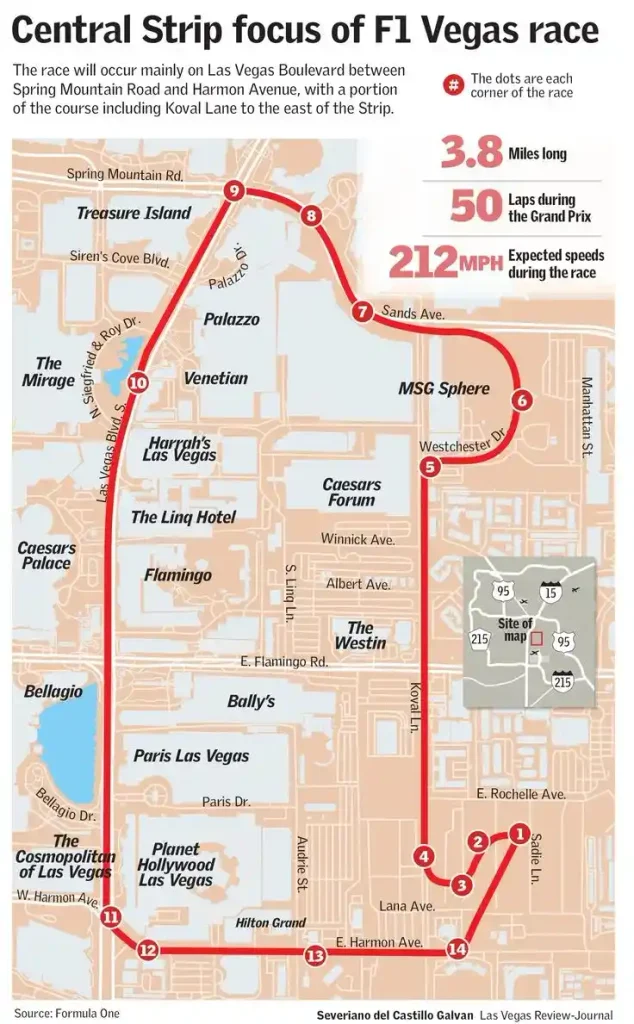
This area contains the start-finish straight, pit lane, team garages, paddock facilities, and hospitality spaces.
After leaving the permanent section, drivers move onto public streets that are temporarily converted into a Formula 1 racing circuit.
One of the defining characteristics of the track is its speed. Long, wide Las Vegas roads allow drivers to reach very high speeds before braking for relatively slow corners.
Las Vegas F1 Route: Sector by Sector
The circuit is divided into three timing sectors, each presenting a different challenge.
Sector 1: Grand Prix Plaza and Koval Lane
The lap begins at Grand Prix Plaza before drivers tackle the opening corners and accelerate toward Koval Lane.
This section combines slower corners with acceleration zones, making the opening lap particularly interesting when the entire field is close together.
Drivers need good traction when exiting these slower sections because losing momentum can affect their speed down the following straights.
Sector 2: Sphere and Sands Avenue
The middle portion of the Las Vegas F1 route takes drivers toward the Sphere area.
This is one of the most visually recognizable sections of the circuit because the Sphere’s enormous exterior display sits beside the track.
Drivers negotiate a sequence of corners before heading toward Sands Avenue. Compared with the long Strip straight, this section places greater emphasis on positioning, braking, and traction.
Sector 3: Las Vegas Boulevard
The most recognizable section arrives when Formula 1 cars reach Las Vegas Boulevard.
Drivers accelerate along the Strip past several major Las Vegas resorts before reaching one of the circuit’s strongest braking zones.
The combination of high speed and heavy braking can create overtaking opportunities, particularly when cars are running closely together.
Understanding the 17 Turns
The circuit contains 17 turns, ranging from slower corners to faster bends.
Turn 1 arrives shortly after the start-finish line and can become particularly busy on the opening lap as drivers compete for position.
The following sequence leads toward Koval Lane before the circuit continues toward the Sphere section.
The corners around the Sphere require drivers to manage braking and acceleration carefully while remaining close to the barriers common on street circuits.
After the Sands Avenue section, drivers eventually reach Las Vegas Boulevard and begin the circuit’s fastest stretch.
One of the biggest braking moments comes near the end of the Strip straight. Drivers must reduce speed dramatically before turning away from Las Vegas Boulevard.
The final sequence then leads the cars back toward Grand Prix Plaza and the start-finish line.
Where to Watch the Las Vegas Grand Prix
Your preferred viewing area depends on whether you want to see race starts, cornering, braking, or high-speed action.
Grand Prix Plaza
Grandstands around Grand Prix Plaza provide views of the start-finish area, pit lane activity, and opening section of the circuit.
This area can be particularly appealing for spectators interested in the race start, pit stops, and finish.
Sphere Zone
The Sphere section combines racing with one of the most recognizable backdrops in Las Vegas.
Spectators here can watch drivers negotiate a more technical part of the circuit rather than simply seeing cars at maximum speed.
Strip Viewing Areas
Viewing areas along or near Las Vegas Boulevard emphasize speed. Ticket locations and hospitality areas vary from year to year, so check the official event map before purchasing tickets.
Getting Around Las Vegas During F1 Weekend
The Las Vegas Grand Prix significantly changes traffic patterns around the Strip.
Road closures, temporary barriers, pedestrian routes, and bridge systems can make familiar walking and driving routes different during race week.
If you are staying near the circuit, allow extra time when traveling between your hotel and another part of the Strip.
The Las Vegas Monorail can be particularly useful because it serves several resorts along the east side of the Strip without relying on Las Vegas Boulevard traffic.
Walking is still practical for some trips, but distances can increase because race infrastructure may require pedestrian detours.
Conclusion
The Las Vegas F1 Track Map combines one of America’s most recognizable tourist areas with a fast Formula 1 street circuit. Its 3.853-mile route, 17 turns, long Las Vegas Boulevard straight, and technical sections around the Sphere create several different viewing experiences.
If you’re attending the race, study the official circuit and pedestrian maps before leaving your hotel. Road closures and temporary routes can change how you move around the Strip during Grand Prix weekend.
FAQ
How long is the Las Vegas F1 track?
The Las Vegas Strip Circuit measures approximately 3.853 miles (6.201 km) per lap.
How many turns does the Las Vegas F1 circuit have?
The circuit has 17 turns and runs counter-clockwise.
Is Las Vegas F1 a street circuit?
Yes. Most of the circuit uses public roads temporarily converted for racing, while Grand Prix Plaza provides permanent Formula 1 facilities.
Where is the main straight?
The most recognizable high-speed section runs along Las Vegas Boulevard, giving drivers a long acceleration zone through the heart of the Strip.
Where can you see overtaking?
Heavy braking areas following long straights generally provide the strongest passing opportunities, although actual overtaking varies from race to race.
Keep Reading: