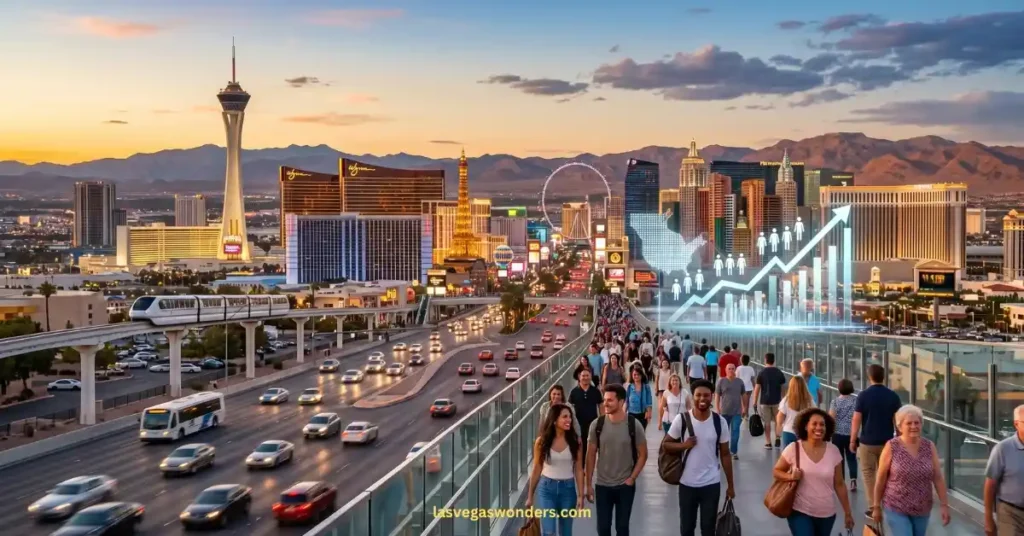
Key Highlights:
- City vs. Metro Population: The City of Las Vegas has approximately 687,000 residents, while the larger Las Vegas-Henderson-Paradise metro area exceeds 3 million people, making it one of the largest metropolitan regions in the Southwest.
- Steady Growth: Las Vegas continues to grow faster than many major U.S. cities, fueled by new residents, job opportunities, and ongoing development across Southern Nevada.
- Where New Residents Come From: California remains the largest source of new arrivals, followed by states such as Texas, Arizona, and Florida.
- A Diverse Community: Las Vegas is one of America’s most diverse cities, with strong Hispanic, Asian, Black, and multicultural communities contributing to the area’s unique culture and economy.
Most visitors associate Las Vegas with casinos, resorts, and entertainment. However, beyond the famous Strip lies a thriving metropolitan area filled with family neighborhoods, business districts, schools, parks, and growing communities.
One of the biggest misconceptions is that the Strip is located within the City of Las Vegas. In reality, most of the Strip sits within the unincorporated community of Paradise in Clark County. That’s why population figures can vary depending on whether you’re looking at the city itself or the entire metropolitan region.
Understanding this distinction provides a much clearer picture of how large and influential Southern Nevada has become.
Las Vegas Population Snapshot
| Area | Population | Median Age | Median Household Income |
|---|---|---|---|
| City of Las Vegas | ~687,000 | 38.6 years | ~$74,000 |
| Las Vegas Metro Area | 3+ million | 38.2 years | ~$75,000 |
| Clark County | 2.4+ million | 38 years | ~$76,000 |
Major Population Centers
- Las Vegas
- Henderson
- North Las Vegas
- Paradise
- Spring Valley
- Summerlin
- Enterprise
Why Las Vegas Keeps Growing
No State Income Tax
Nevada’s lack of a state income tax remains one of the biggest reasons people relocate to Las Vegas. Many families and business owners find the tax savings appealing compared to higher-tax states.
Job Opportunities
While tourism remains important, the local economy has expanded significantly into:
- Healthcare
- Construction
- Logistics and warehousing
- Technology
- Manufacturing
- Professional sports
- Entertainment
Relative Housing Affordability
Compared to major West Coast markets, Las Vegas continues to offer more affordable housing options, attracting both families and retirees.
Professional Sports Expansion
The arrival of major professional sports teams has helped reshape the city’s image and economy:
- Vegas Golden Knights
- Las Vegas Raiders
- Las Vegas Aces
- Athletics
These organizations have contributed to new jobs, investment, and long-term economic growth.
Demographics at a Glance
Las Vegas is one of the most diverse metropolitan areas in the United States.
Population Breakdown
- White (Non-Hispanic): ~40%
- Hispanic or Latino: ~35%
- Black or African American: ~12%
- Asian: ~7%
- Two or More Races: ~19%
The region also has a large international community, with many residents originally from countries such as Mexico, the Philippines, Cuba, and Vietnam.
This diversity helps shape Las Vegas’ food scene, festivals, cultural events, and local neighborhoods.
Popular Areas for Residents
Summerlin
Known for parks, schools, golf courses, and family-friendly neighborhoods.
Henderson
One of Nevada’s fastest-growing cities, offering excellent schools and outdoor recreation.
North Las Vegas
Experiencing significant residential and industrial development.
Spring Valley
A diverse area popular for restaurants, shopping, and convenient access to the Strip.
Tips for Exploring Local Las Vegas
Use the 215 Beltway
The Bruce Woodbury Beltway provides a faster way to move around the valley than driving through the Strip corridor.
Visit Chinatown
The Spring Mountain Road district offers some of the city’s best local restaurants, bakeries, and cafes.
Explore Beyond Tourist Areas
Neighborhoods like Summerlin, Henderson, and Centennial Hills provide a better look at everyday life in Las Vegas.
Visit During Cooler Months
October through April offers the most comfortable weather for neighborhood tours and relocation visits.
Final Thoughts
Las Vegas is far more than a tourist destination. Behind the casinos and resorts is a metropolitan area of more than 3 million people, diverse neighborhoods, growing industries, and a rapidly evolving economy. Whether you’re researching the city, planning a move, or simply curious about its growth, understanding the difference between the city limits and the broader metro area provides the clearest picture of modern Las Vegas.
FAQ
What is the current population of Las Vegas?
The City of Las Vegas has approximately 687,000 residents, while the greater metropolitan area has more than 3 million residents.
Why do some websites show different population numbers?
Some sources report only the City of Las Vegas population, while others include the entire Las Vegas-Henderson-Paradise metropolitan area.
Is Las Vegas still growing?
Yes. Southern Nevada continues to add new residents each year and remains one of the faster-growing metropolitan regions in the United States.
What state sends the most people to Las Vegas?
California consistently provides the largest share of new residents moving to Southern Nevada.
Is Las Vegas a diverse city?
Yes. Las Vegas is highly diverse, with large Hispanic, Asian, Black, and multicultural communities throughout the valley.
Is Las Vegas mainly a retirement destination?
No. While retirees are attracted to the area, Las Vegas also attracts young professionals, families, entrepreneurs, and remote workers.
Keep Reading: